How the In-Plant Process Works
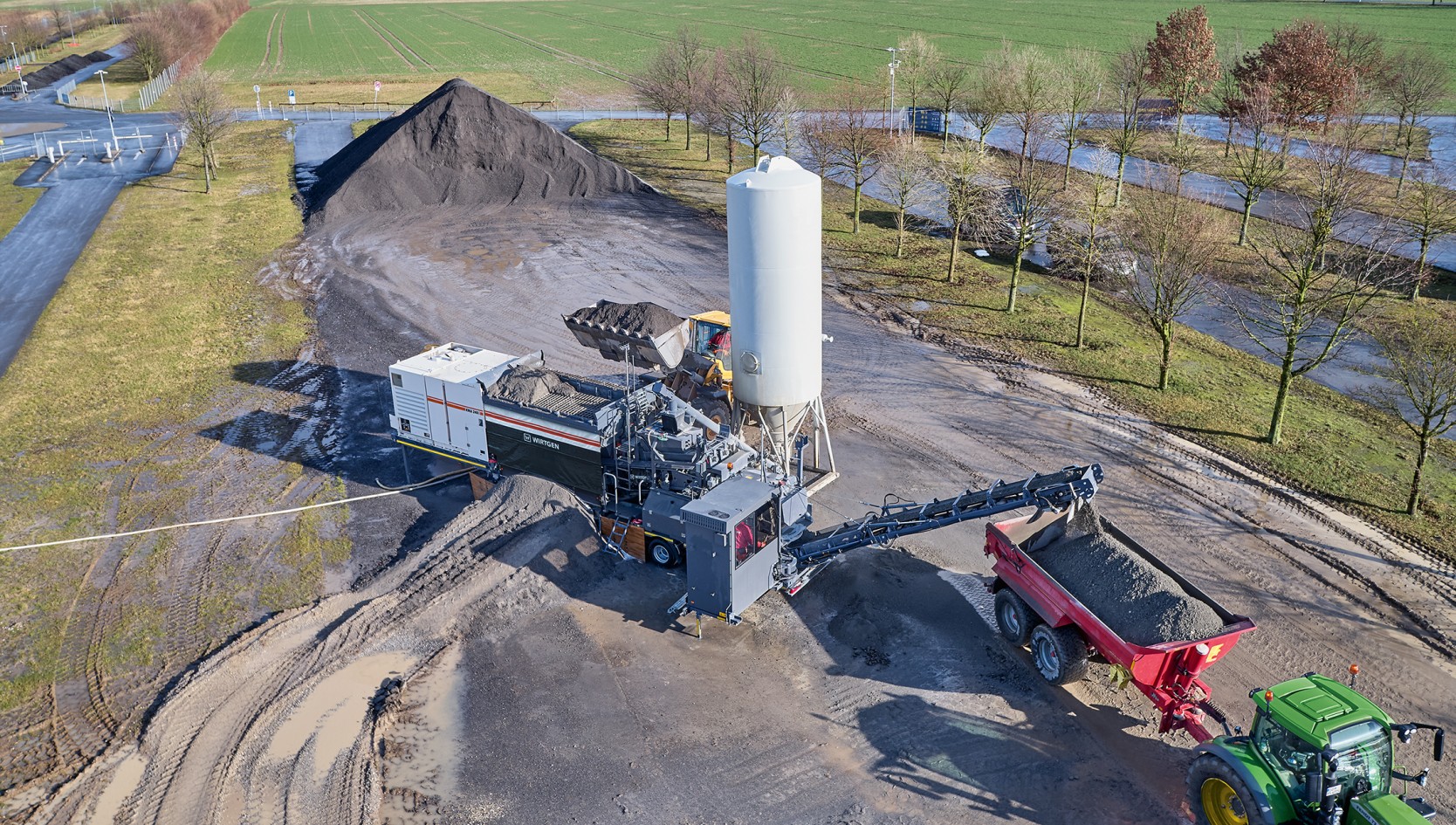

The KMA 240(i) is mounted on a flatbed semi-trailer and his its own engine station. The mobile concept enables quick and easy relocation and rapid set up of the plant on arrival at the new site. Wheel loaders feed a wide variety of unbound raw materials into the hopper via vibrating grates. Silos or tank trucks supply the plant with binding agents such as cement, bitumen emulsion, or foamed bitumen. A microprocessor-controlled plant control system monitors the addition of raw materials and binding agents into the mixing chamber for high-precision dosing. Here, a heavy-duty twin-shaft pugmill mixer produces a high-quality, homogeneous mix. Finally, the finished mix is smoothly loaded onto the slewing discharge conveyor. It even enables the complete filling of long semi-trailer tippers.
The cold recycling mixing plant KMA 240(i) produces cold mix that can be paved immediately for a wide variety of construction projects, such as cement-treated base layers (CTB) for freeways and major highways. Due to the particularly generously-dimensioned, continuous addition of cement, enormous daily outputs can be achieved with maximum precision.
In addition to CTB and RCC (roller-compacted concrete), cold mix can be produced that is stabilized with bitumen emulsion or foamed bitumen (BSM).
The road surfaces produced from these high-quality cold mixes stand out due to their excellent load-bearing capacity, resistance to deformation, and long service life.
The highly mobile cold recycling mixing plant can be easily transported from site to site and quickly set up close-by. This saves time, minimizes on-site transport logistics, and can help to reduce overall costs compared to conventional construction methods – a win-win situation in every respect!
The well-engineered design allows the compact system to be easily and safely ‘packed up’ onto a flat-bed semi-trailer and transported to the next site, saving both time and money. All you need to do is slew in the discharge conveyor and operator’s cabin, move the auger conveyor to the transport position and then hitch up the plant. A standard fifth-wheel tractor unit is completely sufficient for transporting the plant as all of its connectors are standardized.
The compact transport dimensions and low overall weight of the KMA 240(i) comply with international traffic regulations, and generally eliminate the laborious process of applying for a special permit.
At first glance, the KMA 240(i) appears relatively small. But when it comes to performance, the exact opposite is true – the compact plant packs a punch. Powered by a heavy-duty diesel engine, it can produce high-quality mix at an astonishing rate of 240 t/h. Its mixing performance even far exceeds that of many stationary large-scale plants.
But it doesn’t just come down to performance, a continuous supply of materials to the construction site is also a crucial factor.
This is guaranteed by the field-proven loading system of the KMA 240(i). The discharge conveyor features wide slewing angles that make it possible to evenly fill semi-trailer tipper trucs.
With a capacity of 240 t/h, the machine produces a full truckload of 20 tons of mix every five minutes. This means that, for example, an enormous section of a cement-treated or bituminous bound base layer 4.0 m wide, 15 cm thick, and 1.4 km long can be paved every day.
The main components of the plant – the material hopper, the dosing units and the twin-shaft continuous mixer – mesh together perfectly like a precision geartrain and ensure that the binding agents are precisely and simultaneously added to the weighed raw material in the mixer. The end result is a mix quality that precisely matches the required recipe.
The innovative double trough system features two independent, state-of-the-art weighing units. This allows cement to be dosed gravimetrically from one trough while the other trough is simultaneously being filled with more cement and precisely weighed. Alternating dosing is carried out with the highest precision and without interrupting the addition of binding agents.


